
What Is Section 24 of the Bharatiya Sakshya Adhiniyam?
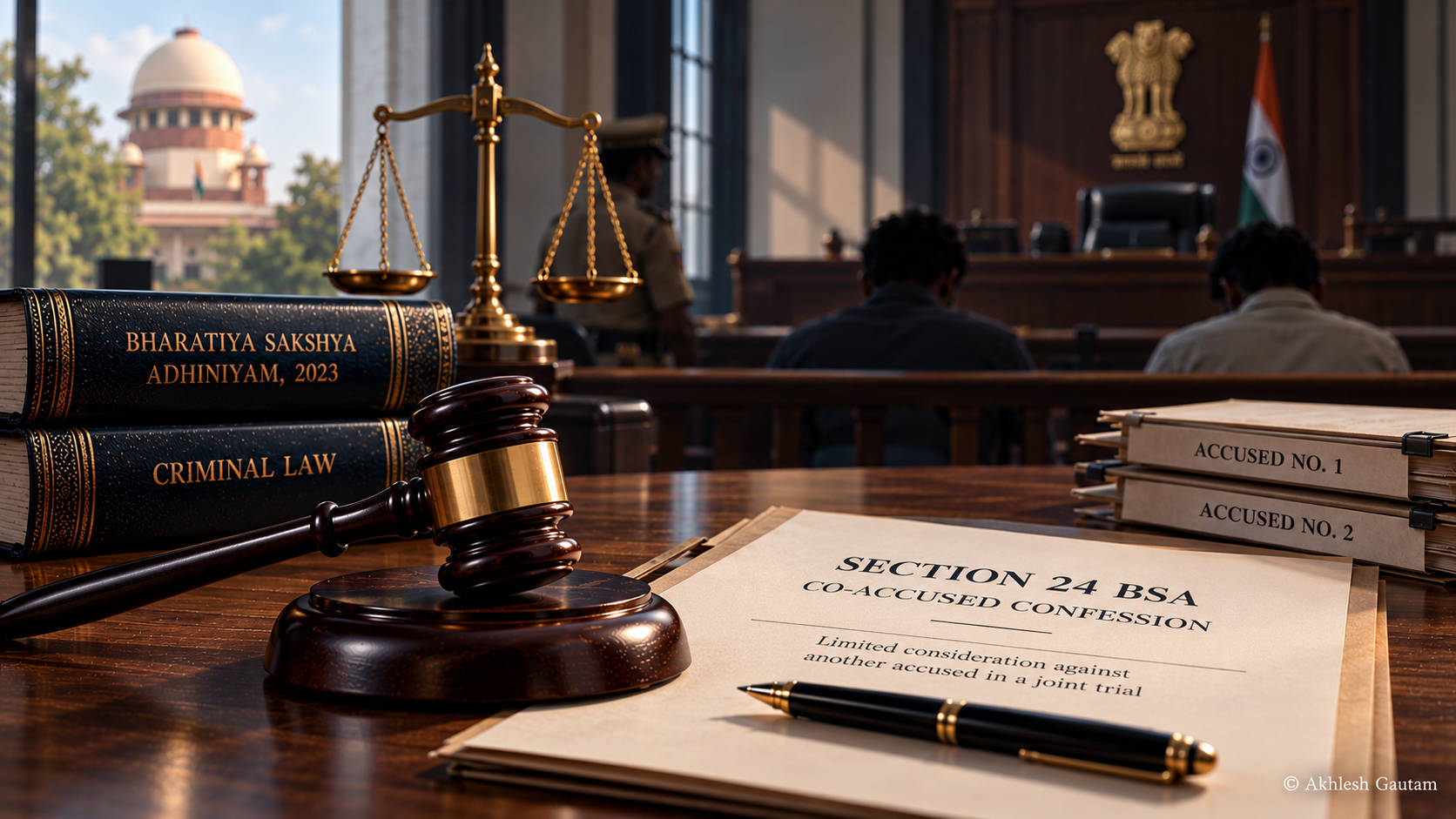
Section 24 BSA governs the limited consideration of a confession made by one accused that also implicates another accused in the same offence.
It allows a court to consider a legally proved confession against both individuals when the statutory conditions are satisfied.
However, this does not mean that every statement made by one accused can be used as evidence against another person.
Section 24 broadly corresponds to Section 30 of the former Indian Evidence Act, 1872.
The provision recognizes a distinction between a confession that may be considered by the court and independent evidence capable of establishing guilt.
Requirements Under Section 24 BSA
For Section 24 to apply, the following requirements must ordinarily be satisfied:
1. The accused persons must be jointly tried.
Two or more persons must be jointly tried for the same offence. The statute also recognizes abetment and attempts within the meaning of the offence.
2. The statement must be a confession.
The statement must admit the maker's own involvement in the offence. Merely accusing another person without admitting personal involvement is not sufficient.
3. The confession must implicate both accused persons.
It must affect the person making the confession as well as another accused.
4. The confession must be legally proved.
The statement must satisfy the applicable rules of admissibility. An inadmissible confession made to police does not become valid simply because multiple accused persons are being tried together.
Section 24 also contains a specific explanation treating certain trials conducted in the absence of an absconding accused, or an accused who fails to comply with a proclamation under Section 84 BNSS, as joint trials for this purpose.
Example: Can One Accused's Confession Be Used Against Another in a Murder Case?
Suppose A and B are accused of murdering C and are jointly tried before a criminal court.
A makes a legally admissible confession stating:
"A and B committed the murder together."
Because A admits personal involvement and also implicates B, the court may consider the confession against B, subject to Section 24 BSA.
However, consider another situation.
A states:
"I did not commit the murder. B alone killed C."
This statement does not amount to the same kind of confession because A denies personal involvement.
Section 24 cannot be used merely to convert an accusation against another person into proof of guilt.
Similarly, if A makes an inadmissible confession during police interrogation, that confession does not automatically become admissible under Section 24.
Can a Co-Accused's Confession Alone Lead to Conviction?
No. A co-accused's confession cannot ordinarily serve as the sole foundation for convicting another accused.
The Supreme Court has explained that such a confession has limited evidentiary value and is not substantive evidence against a co-accused.
Substantive evidence includes legally admissible material that can independently establish relevant facts, such as credible witness testimony or properly proved documentary evidence.
A co-accused's confession cannot replace the prosecution's responsibility to establish guilt beyond reasonable doubt.
The court must first examine the independent evidence and may then consider a legally proved co-accused confession for its limited supporting value.
Important Supreme Court Judgment: Kashmira Singh v. State of Madhya Pradesh (1952)
In Kashmira Singh v. State of Madhya Pradesh, AIR 1952 SC 159, the Supreme Court examined the evidentiary value of a confession made by one accused against another.
What Was the Legal Issue?
The Court considered how far a co-accused's confession could be used to establish another person's involvement in a criminal offence.
The central concern was whether such a confession could form the foundation of conviction or whether independent evidence was necessary.
What Did the Supreme Court Decide?
The Supreme Court explained that a co-accused's confession is a weak form of evidence against another accused.
Unlike ordinary witness testimony, the confession is not necessarily made under oath in the presence of the other accused and cannot be tested through cross-examination in the same way.
The Court held that the proper approach is to examine the independent evidence first.
Only when the independent evidence is sufficient in law, and the court requires additional assurance about its reliability, may the confession be considered for that limited supporting purpose.
A co-accused's confession cannot fill essential gaps in the prosecution's evidence or independently establish another accused's guilt.
Why Is This Judgment Important Today?
Although Kashmira Singh interpreted Section 30 of the Indian Evidence Act, 1872, the principle remains relevant because Section 24 BSA substantially preserves the corresponding statutory rule.
The judgment helps explain why the court must distinguish between considering a confession and treating it as independent proof of guilt.
Difference Between Sections 23 and 24 BSA
Although both provisions concern confessions, they address different legal questions.
Section 23 BSA: Confessions Made to Police
Section 23 generally prohibits the use of confessions made to police officers and regulates confessions made while in police custody.
It also provides a limited exception for information that leads to the discovery of a fact.
Section 24 BSA: Confessions Affecting Jointly Tried Accused Persons
Section 24 allows courts to consider certain legally proved confessions that affect both the maker and another accused jointly tried for the same offence.
The important distinction is that Section 24 does not override the restrictions imposed by Section 23.
A police confession that is legally inadmissible cannot automatically be used against another accused simply because both are facing the same criminal trial.
How Does Section 24 BSA Apply to a Co-Accused's Police Disclosure Statement?
Suppose police arrest A in a cheating or criminal conspiracy case.
During interrogation, A states that B was also involved.
Does this automatically allow the court to treat A's statement as evidence against B?
No.
A police disclosure statement and a legally proved confession under Section 24 are not necessarily the same.
The court must examine whether the statement amounts to a confession, whether it is legally admissible, and whether the statutory joint-trial requirements are satisfied.
Where the statement is merely an inadmissible police confession, Section 24 cannot make it admissible against B.
However, police may investigate the allegation and collect other legally relevant evidence, subject to the applicable law.
Legal References
[1] Bharatiya Sakshya Adhiniyam, 2023 — Section 24. Consideration of legally proved confessions involving jointly tried accused persons.
[2] Bharatiya Sakshya Adhiniyam, 2023 — Section 23. Restrictions on police confessions and confessions made while in police custody.
[3] Kashmira Singh v. State of Madhya Pradesh, AIR 1952 SC 159. Supreme Court judgment dated 4 March 1952, explaining the limited evidentiary value of a co-accused's confession.
[4] Indian Evidence Act, 1872 — Section 30. Former provision corresponding to Section 24 BSA.
Frequently Asked Questions
Q1. Can a co-accused's confession alone be used to convict another accused?
Q2. Is a confession made to police admissible under Section 24 BSA?
Q3. Can one accused's confession be considered if both accused persons are not jointly tried?
Q4. What happens if an accused confesses but denies personal involvement in the offence?
Q5. What is the difference between Sections 23 and 24 of the Bharatiya Sakshya Adhiniyam?
Disclaimer
This article is published for general legal information and educational purposes only. It provides an overview of Section 24 of the Bharatiya Sakshya Adhiniyam, 2023, and the legal principles discussed in Kashmira Singh v. State of Madhya Pradesh (1952). It does not constitute legal advice or establish an advocate-client relationship.
The admissibility and evidentiary value of a co-accused's confession depend on the facts of each case, the nature of the statement, the applicable law and the circumstances of the criminal proceedings. The principles discussed do not guarantee acquittal, discharge, bail or any other legal relief.
Readers should consult a qualified legal professional for advice specific to their case. In the event of any inconsistency, the applicable statutory provisions and authoritative judicial decisions shall prevail.

Reader comments
Write a comment
Your email remains private. Comments are reviewed before publication.