
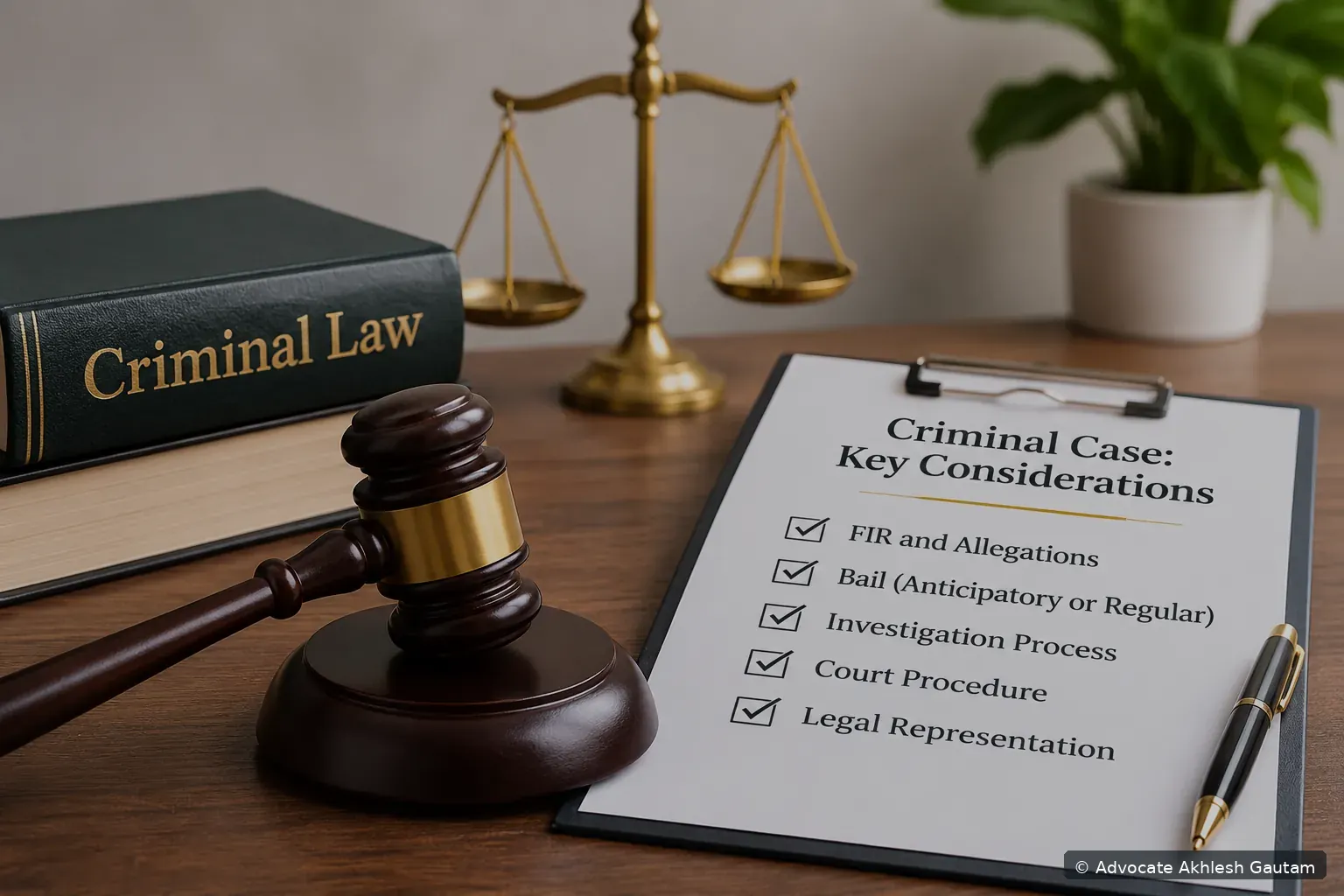
Imagine receiving a phone call late at night. Someone from your family has been arrested.
You don't know what happened. You don't know where to go. And the only question running through your mind is:
“How can we get bail?”
You may immediately search Google for the best advocate for bail matter in bhopal, hoping to find someone who can explain the next steps.
But before approaching the court, there are a few important things every family should understand.
Bail is not simply about submitting an application. The allegations, evidence, type of offence and stage of the case all matter.
Sometimes, even a small detail in the FIR or a previous court order can become important when the court considers bail.
So, what should families actually know?
What Does Bail Mean in a Criminal Case?
Bail generally allows an accused person to remain outside custody while complying with conditions imposed by the competent authority or court.
It does not mean that the criminal case has ended or that the person has been declared innocent.
In India, different bail procedures apply depending on the offence and circumstances.
For example:
Regular Bail: Generally sought after a person has been arrested or taken into custody.
Anticipatory Bail: Pre-arrest protection that may be sought when a person reasonably apprehends arrest for a non-bailable offence, subject to legal restrictions.
Interim Bail: Temporary bail relief that may be granted in appropriate circumstances.
Understanding the difference is important because the wrong approach can cause unnecessary procedural difficulties.
Which Court Can Grant Bail in Bhopal?
The appropriate court depends on the nature of the offence, the applicable law and the procedural stage.
Bail matters may involve:
Magistrate Court: Handles bail applications within its legal jurisdiction.
Sessions Court: Considers bail applications in matters falling within its jurisdiction, including serious offences.
High Court of Madhya Pradesh: May consider bail applications under its statutory jurisdiction.
An application cannot be decided simply by choosing whichever court appears most convenient.
The proper legal procedure must be followed.
What Should Families Check Before Filing a Bail Application?
When a family member is arrested, it is natural to want immediate action.
However, preparing a bail application requires understanding the case.
Some important questions include:
What sections are mentioned in the FIR?
Is the alleged offence bailable or non-bailable?
Has the accused already been arrested?
Is the investigation ongoing?
Has a charge sheet been filed?
Has any previous bail application been rejected?
Does a special law apply?
These details help determine which bail remedy may be available.
One important point: The same bail strategy cannot be applied to every criminal case.
For example, a bail application in a cheating case may involve different legal considerations from an application under the NDPS Act.
What Happens if the Sessions Court Rejects Bail?
This is a common concern among families.
Suppose someone has been arrested and their bail application is rejected by the Sessions Court.
Does that mean bail is no longer possible?
Not necessarily.
Depending on the facts and applicable law, an appropriate bail application may still be considered before the High Court.
However, the reasons for the earlier rejection are important.
The court may examine matters such as:
The seriousness of the alleged offence.
The available evidence.
The role attributed to the accused.
The possibility of influencing witnesses.
The need for further investigation.
The length of custody and other relevant circumstances.
A previous rejection does not automatically decide every future application, but repeated applications must have a legally sustainable basis.
Why Are Some Bail Applications Rejected?
Many people believe that bail will be granted if the accused has no previous criminal record or promises to cooperate.
These factors may be relevant, but they are not always sufficient.
Courts consider several legal and factual issues.
Bail may be refused where the circumstances raise serious concerns about the accused absconding, interfering with evidence or influencing witnesses.
Special laws can also impose additional restrictions.
For example, certain NDPS offences involving commercial quantities are subject to stricter statutory conditions.
This is why it is important to understand the legal requirements before filing an application.
What Documents Are Useful for a Bail Application?
Document requirements depend on the case, but families can generally begin by gathering:
A copy of the FIR, if available.
Arrest or custody-related records.
Details of the alleged offence.
Previous bail applications and rejection orders.
Relevant court orders.
Supporting documents connected with the allegations.
If some documents are not available, that does not necessarily mean no legal step can be taken. The applicable procedure and available records must be examined.
How Do You Choose Legal Assistance for a Bail Matter?
When searching for the best advocate for bail matter in bhopal, families should look beyond promises of quick results.
It may be useful to understand whether the legal professional can clearly explain:
The allegations and applicable legal provisions.
The available bail remedies.
Which court has jurisdiction.
The documents required.
The possible legal difficulties.
The next procedural steps.
Clear communication and a proper review of the case are more useful than assurances of guaranteed bail.
Understanding the Case Is the First Step
When someone close to you is arrested, uncertainty can make every moment difficult.
Families often want immediate answers, but bail proceedings depend on legal provisions, evidence, court jurisdiction and the circumstances of the individual case.
Before filing an application, it is useful to understand what the FIR alleges, which bail remedy may be available and what the court will need to consider.
A well-informed decision begins with understanding the legal position—not with a promise of a particular result.
If you or your family need clarification about a bail matter in Bhopal, you may visit our office in Bhopal with the available case documents to discuss the circumstances and applicable legal procedure.
Frequently Asked Questions
Can bail be granted on the same day?
It may be possible in certain cases, depending on the offence, court procedure, listing and circumstances. Same-day release cannot be assumed.
Can an accused person apply for bail without a charge sheet?
Yes, bail may be sought before the charge sheet is filed, subject to applicable legal requirements.
Is anticipatory bail available after arrest?
Anticipatory bail is a pre-arrest remedy. Once a person has been arrested, the appropriate post-arrest bail procedure generally becomes relevant.
Can the High Court grant bail after Sessions Court rejection?
Yes, in appropriate cases, subject to the applicable law and the circumstances of the matter.
Does bail mean the criminal case is finished?
No. Bail concerns custody and liberty during criminal proceedings. The investigation or trial may continue.
Disclaimer: This article is intended for general legal information only. It does not constitute legal advice, create an advocate-client relationship or guarantee bail or any judicial outcome. Every criminal case requires individual legal assessment.

Reader comments
Write a comment
Your email remains private. Comments are reviewed before publication.