
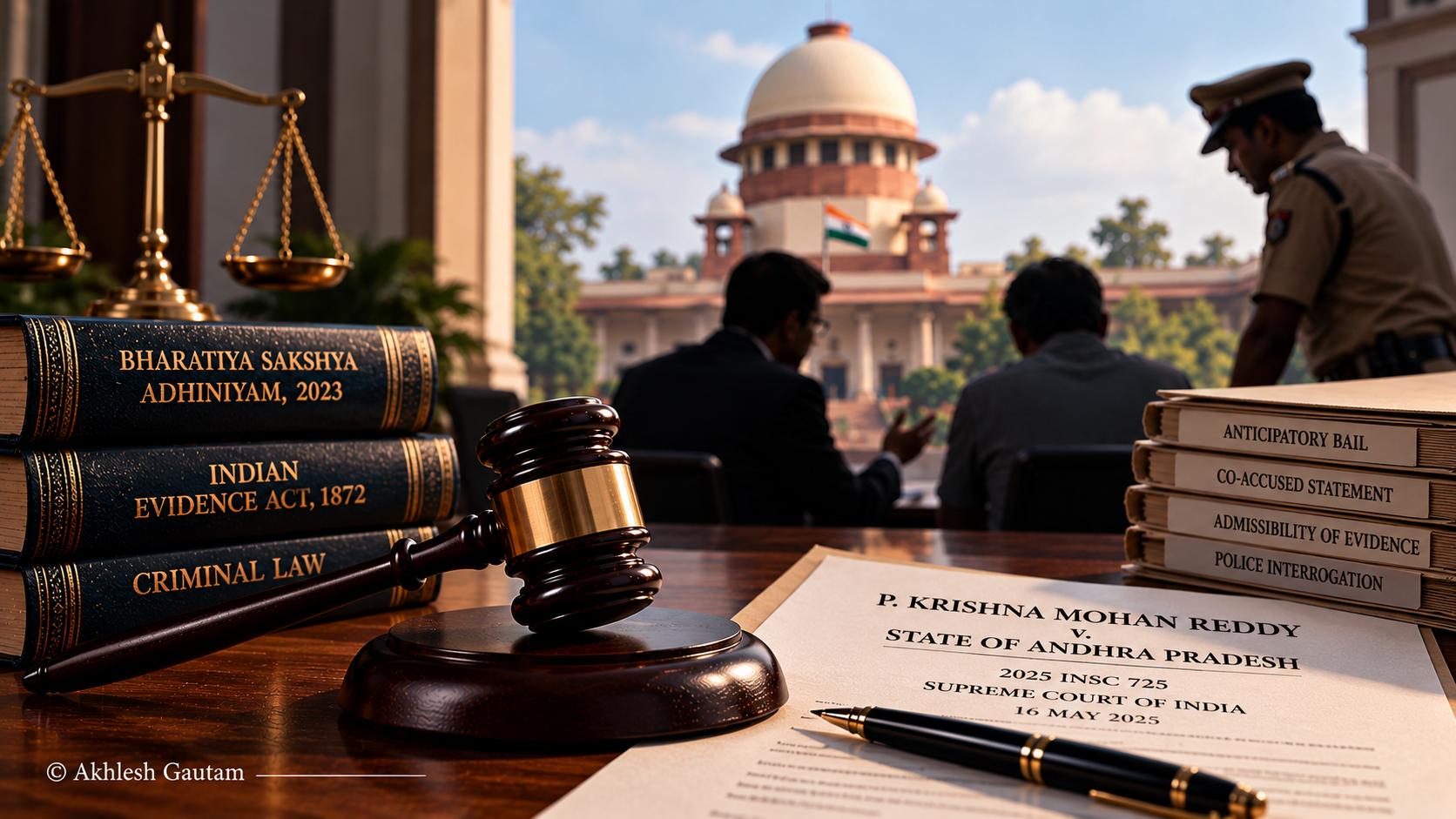
Judgment Details
Court: Supreme Court | Case: SLP (Criminal) Nos. 7532, 7533 and 7534 of 2025 | Date: 2025-05-16
Acts / Sections: Section 30 Evidence Act, Section 23 BSA, Section 24 BSA, Section 482 BNSS.
Case DetailsCase Name: P. Krishna Mohan Reddy v. State of Andhra Pradesh Court: Supreme Court of India Citation: 2025 INSC 725 Judgment Date: 16 May 2025 Bench: Justice J.B. Pardiwala and Justice R. Mahadevan Case Numbers: SLP (Criminal) Nos. 7532, 7533 and 7534 of 2025 Main Legal Issues: Anticipatory bail, admissibility of police statements and evidentiary value of co-accused confessions. |
The case arose from an investigation into alleged irregularities in Andhra Pradesh's liquor policy.
The prosecution alleged manipulation of liquor procurement and distribution arrangements, financial irregularities and a wider criminal conspiracy involving public officials and other individuals.
Crime No. 21/2024 was registered at the CID Police Station, Mangalagiri, Andhra Pradesh.
The alleged offences included:
Section 409 IPC: Criminal breach of trust by a public servant, banker, merchant or agent.
Section 420 IPC: Cheating and dishonestly inducing delivery of property.
Section 120B IPC: Criminal conspiracy.
Sections 34 and 37 IPC: Principles concerning joint criminal liability and intentional cooperation.
Sections 7, 7A, 8, 13(1)(b) and 13(2) of the Prevention of Corruption Act, 1988: Corruption-related offences.
These were allegations under investigation, not findings that the petitioners had committed the offences.
Two petitioners approached the Supreme Court after the Andhra Pradesh High Court refused their anticipatory bail applications. A third connected petition concerned an accused who had already been arrested.
The Supreme Court examined the bail issues and the legal treatment of statements made by accused persons during police investigation.
What Were the Main Legal Issues Before the Supreme Court?
The Court considered three important questions.
First: Can police statements made by one accused be relied upon against another accused during anticipatory or regular bail proceedings?
Second: What is the difference between a confession, an incriminating admission and a statement denying personal involvement?
Third: Does cooperation with the investigation, or the absence of a demonstrated need for custodial interrogation, automatically entitle a person to anticipatory bail?
These questions are important because information collected during investigation is not necessarily admissible evidence against every person mentioned in it.
Difference Between a Confession, Admission and Exculpatory Statement
The Supreme Court examined different types of statements made during police interrogation.
Confessional Statement
A confession is a statement in which an accused admits guilt or substantially admits the facts constituting an offence.
For example:
"I committed the fraud with another person."
Confessions made to police officers are generally inadmissible under the applicable evidence law.
Incriminating Admission
An incriminating admission acknowledges a fact that may be adverse to the person making it, without necessarily admitting the complete offence.
For example:
"I received money from the person being investigated."
Such a statement may have legal significance, but it does not automatically establish criminal guilt.
An admission made by one accused cannot ordinarily be used against another accused merely because it is incriminating.
Exculpatory Statement
An exculpatory statement is one in which a person denies guilt or attempts to explain away personal involvement.
For example:
"I was not involved in the fraud. The other accused handled everything."
The Court clarified that an accused cannot implicate another person merely through such a police statement and have it treated as evidence against that person.
Can a Co-Accused's Police Statement Be Used to Oppose Anticipatory Bail?
The Supreme Court explained that statements recorded from an accused person during police investigation must be distinguished from statements given by ordinary witnesses.
Under the Indian Evidence Act, 1872, Sections 25 and 26 generally restrict the admissibility of police confessions and confessions made in police custody.
The Court also examined Section 30, which permits limited consideration of certain legally proved confessions involving persons jointly tried for the same offence.
However, this exception does not automatically operate during anticipatory or regular bail proceedings.
A confession must first satisfy the legal requirements governing admissibility and proof.
Therefore, an inadmissible police confession cannot be relied upon against another accused merely because the prosecution refers to it during a bail hearing.
The Court also explained that an exculpatory statement made by one accused, while implicating another, cannot ordinarily be treated as evidence against that other accused.
Did the Supreme Court Grant Anticipatory Bail?
No. The Supreme Court declined to interfere with the High Court's refusal of anticipatory bail to the two petitioners seeking that protection.
The Court considered the seriousness of the alleged offences, the nature of the investigation, the material placed before it and concerns regarding custodial interrogation and interference with witnesses.
It explained that the need for custodial interrogation is a relevant consideration, but bail decisions cannot depend on that factor alone.
Similarly, an applicant's cooperation with police does not create an automatic right to anticipatory bail.
The Court must examine the overall circumstances, including the nature of the alleged offence and the legally relevant material.
This is an important distinction: the exclusion of an inadmissible police statement does not automatically mean anticipatory bail must be granted.
In the third connected petition, the accused had already been arrested. The Supreme Court left questions concerning further remand and regular bail to be determined by the competent court according to law.
What Did the Supreme Court Say About Police Interrogation?
The Supreme Court also emphasized that criminal investigations must be conducted fairly.
In paragraph 54, the Court cautioned investigating agencies against using coercion, undue pressure, improper influence or third-degree methods to obtain statements from witnesses or accused persons.
It stressed that serious allegations do not justify unlawful interrogation practices.
The investigating agency must collect evidence through lawful methods while respecting the rights of the persons involved.
How Does This Judgment Apply When a Co-Accused Names Another Person?
Suppose A is arrested in a criminal conspiracy case.
During police interrogation, A tells investigators:
"B was also involved in the conspiracy."
Police may investigate this information and look for supporting material.
However, A's police statement does not automatically become admissible evidence against B.
If B applies for anticipatory bail, the court must consider the applicable evidentiary restrictions and other legally relevant circumstances.
The prosecution may rely on independently collected material, such as financial transactions, witness statements or digital records, where the law permits.
The Supreme Court's judgment does not prevent investigation or guarantee bail. It explains why an accused person's police statement must not be treated as legally admissible proof against another accused without satisfying the applicable rules.
What Is the Legal Importance of This Judgment Under the New Criminal Laws?
The Supreme Court principally examined the relevant provisions of the Indian Evidence Act, 1872, and the Code of Criminal Procedure, 1973.
Under the newer criminal-law framework:
Section 23 BSA governs restrictions on confessions made to police officers and in police custody.
Section 24 BSA concerns the limited consideration of certain legally proved confessions involving jointly tried accused persons.
Section 482 BNSS governs anticipatory bail.
Section 528 BNSS preserves the inherent powers of the High Court.
Conclusion
P. Krishna Mohan Reddy v. State of Andhra Pradesh, 2025 INSC 725, is an important Supreme Court judgment concerning the evidentiary value of police statements and the principles governing anticipatory bail.
The Court clarified that inadmissible police confessions and statements made by accused persons cannot automatically be relied upon against other accused persons in bail proceedings.
However, it also made clear that anticipatory bail depends on the overall facts, seriousness of the allegations and applicable legal considerations.
The judgment reinforces two essential principles: criminal investigations must respect evidentiary and constitutional safeguards, and bail applications must be decided through an independent judicial assessment of the case.
Legal References
[1] P. Krishna Mohan Reddy v. State of Andhra Pradesh, 2025 INSC 725. Supreme Court of India, judgment dated 16 May 2025, particularly paragraphs 18–24 and 40–57.
[2] Indian Evidence Act, 1872 — Sections 17, 21, 24–30. Provisions concerning admissions, confessions, their admissibility and consideration of confessions involving co-accused persons.
[3] Code of Criminal Procedure, 1973 — Sections 161, 162, 315 and 438. Provisions concerning police examination, use of statements, accused persons appearing as witnesses and anticipatory bail.
[4] Bharatiya Sakshya Adhiniyam, 2023 — Sections 23 and 24. Corresponding provisions concerning police confessions and certain jointly tried accused persons.
[5] Bharatiya Nagarik Suraksha Sanhita, 2023 — Section 482. Provision concerning anticipatory bail.
Frequently Asked Questions
Q1. Can a co-accused's police statement be used against another accused during anticipatory bail proceedings?
Q2. Is a confession made to police admissible under Indian evidence law?
Q3. Did the Supreme Court grant anticipatory bail in the P. Krishna Mohan Reddy case?
Q4. Can a co-accused's confession alone establish another person's guilt?
Q5. Does cooperation with police guarantee anticipatory bail?
Disclaimer
This article is published for general legal information and educational purposes only. It provides a simplified explanation of the Supreme Court's judgment in P. Krishna Mohan Reddy v. State of Andhra Pradesh, 2025 INSC 725, and should not be treated as legal advice or a substitute for professional consultation.
The facts, observations and findings discussed in this article relate to the specific proceedings before the Supreme Court. They should not be interpreted as establishing the guilt or innocence of any person or guaranteeing anticipatory bail, regular bail or any other legal relief.
The application of this judgment depends on the facts of each case, the nature of the allegations, available evidence, applicable statutory provisions and subsequent judicial developments. Readers should consult a qualified legal professional before taking action in any criminal matter.
In the event of any difference between this article and the official judgment, the original judgment and applicable law shall prevail.
Full Judgment
For help obtaining or reviewing the complete judgment, request a consultation. Availability and applicable fees will be confirmed before proceeding.