
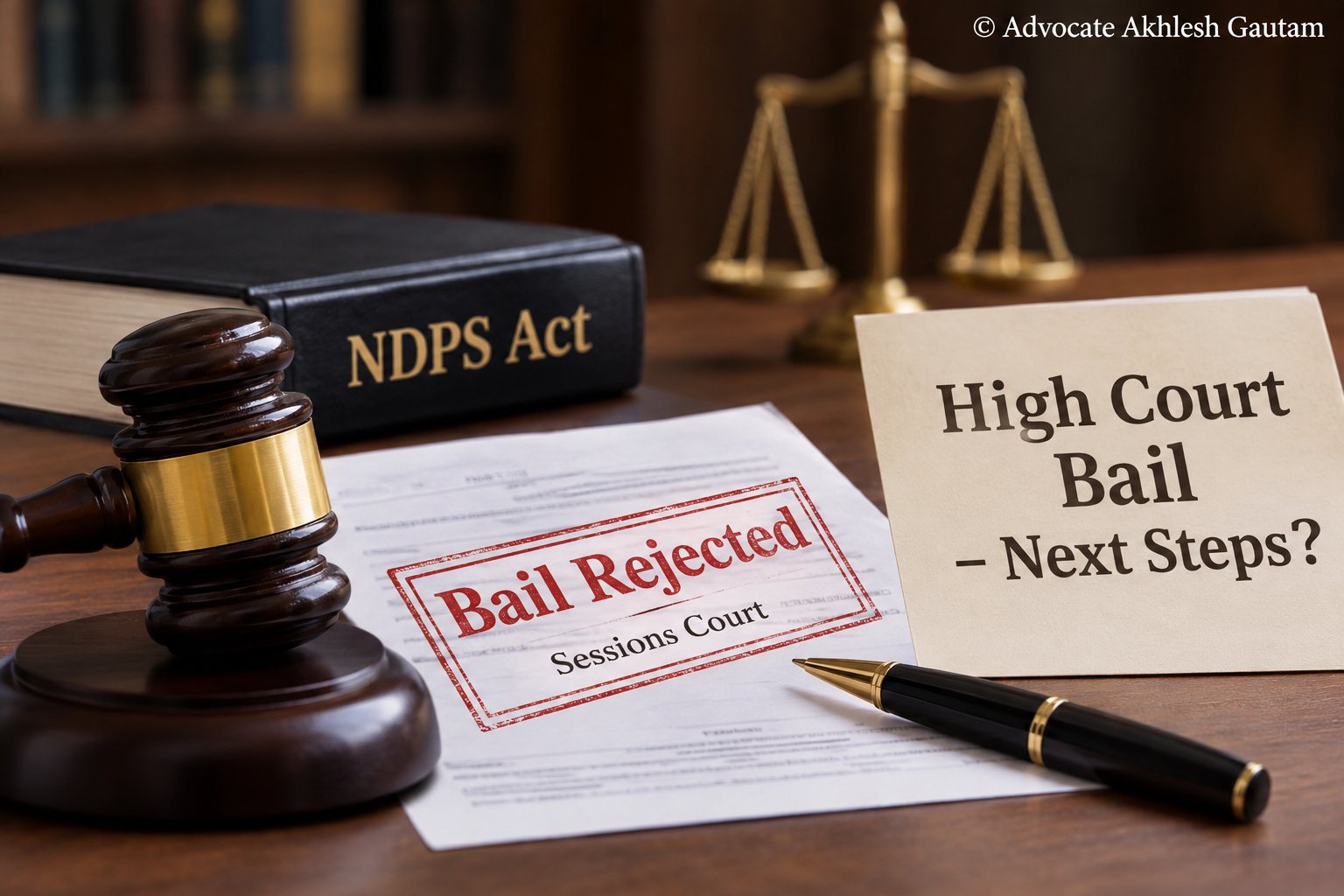
Your NDPS bail application has been rejected by the Sessions Court. Does that mean you must remain in jail until the trial ends?
Not necessarily.
NDPS bail rejected by Sessions Court does not automatically mean that every legal option is exhausted. An accused person may approach the High Court for bail, subject to the applicable law and circumstances of the case.
However, the next bail application must address an important question: Why was bail refused, and what legal grounds can justify a different decision?
Can You Get NDPS Bail from the High Court?
Yes. The High Court has jurisdiction to consider a regular bail application even after the Sessions Court has rejected bail.
Under Section 483 of the Bharatiya Nagarik Suraksha Sanhita (BNSS), 2023, the High Court has special powers concerning bail. The corresponding provision under the earlier CrPC was Section 439.
But an NDPS bail application is not decided merely because the accused has approached a higher court.
The alleged quantity of narcotics, applicable NDPS provisions, evidence, custody period and reasons recorded in the rejection order may all influence the decision.
Which NDPS Sections Matter After Bail Rejection?
Section 37: Imposes additional bail restrictions for specified offences, including commercial quantity cases.
Sections 20, 21 and 22: Concern different categories of narcotic drugs and psychotropic substances.
Section 29: Concerns abetment and criminal conspiracy.
Section 36A(4): Contains special provisions relating to investigation periods for specified NDPS offences.
Important: Section 37 does not impose identical restrictions on every NDPS case. Its stricter conditions apply to offences specified in that provision.
What Has the Supreme Court Said About NDPS Bail?
The Supreme Court has addressed both the strict statutory requirements and constitutional considerations involved in NDPS bail.
1. State of Kerala v. Rajesh, (2020) 12 SCC 122
The Supreme Court emphasised that the mandatory conditions under Section 37 must be satisfied when that provision applies.
2. Mohd. Muslim @ Hussain v. State (NCT of Delhi), 2023
The Supreme Court considered prolonged incarceration and delay in trial in the context of NDPS bail and personal liberty under Article 21.
These judgments demonstrate that NDPS bail depends on legal grounds, not merely on the seriousness of the accusation or the fact of an earlier rejection.
The Important Question After Sessions Court Rejection
Two accused persons facing similar NDPS charges may receive different bail decisions.
Why?
Because the outcome may depend on the nature of the alleged recovery, the accused's role, the evidence available and the precise objections recorded by the Sessions Court.
An argument relevant in one NDPS case may have little value in another.
The most important issue is often hidden in the rejection order itself.
If your NDPS bail has been rejected by the Sessions Court, the next legal step requires careful examination of the bail rejection order, FIR and other available case documents.
For guidance regarding NDPS bail applications, Section 37 restrictions and High Court bail proceedings, contact our office for a case-specific legal assessment.
A Sessions Court rejection may not be the end of your bail options. But the next application must address the reasons for refusal.
Legal Disclaimer
This article is published solely for general legal information and educational purposes. It does not constitute individual legal advice, advertising, solicitation or any guarantee of bail, discharge or acquittal. Legal outcomes depend on the facts, applicable statutory provisions, evidence and decisions of the competent court. Readers should seek independent legal advice regarding their circumstances. Reading this article does not establish an advocate-client relationship.

Reader comments
Write a comment
Your email remains private. Comments are reviewed before publication.